
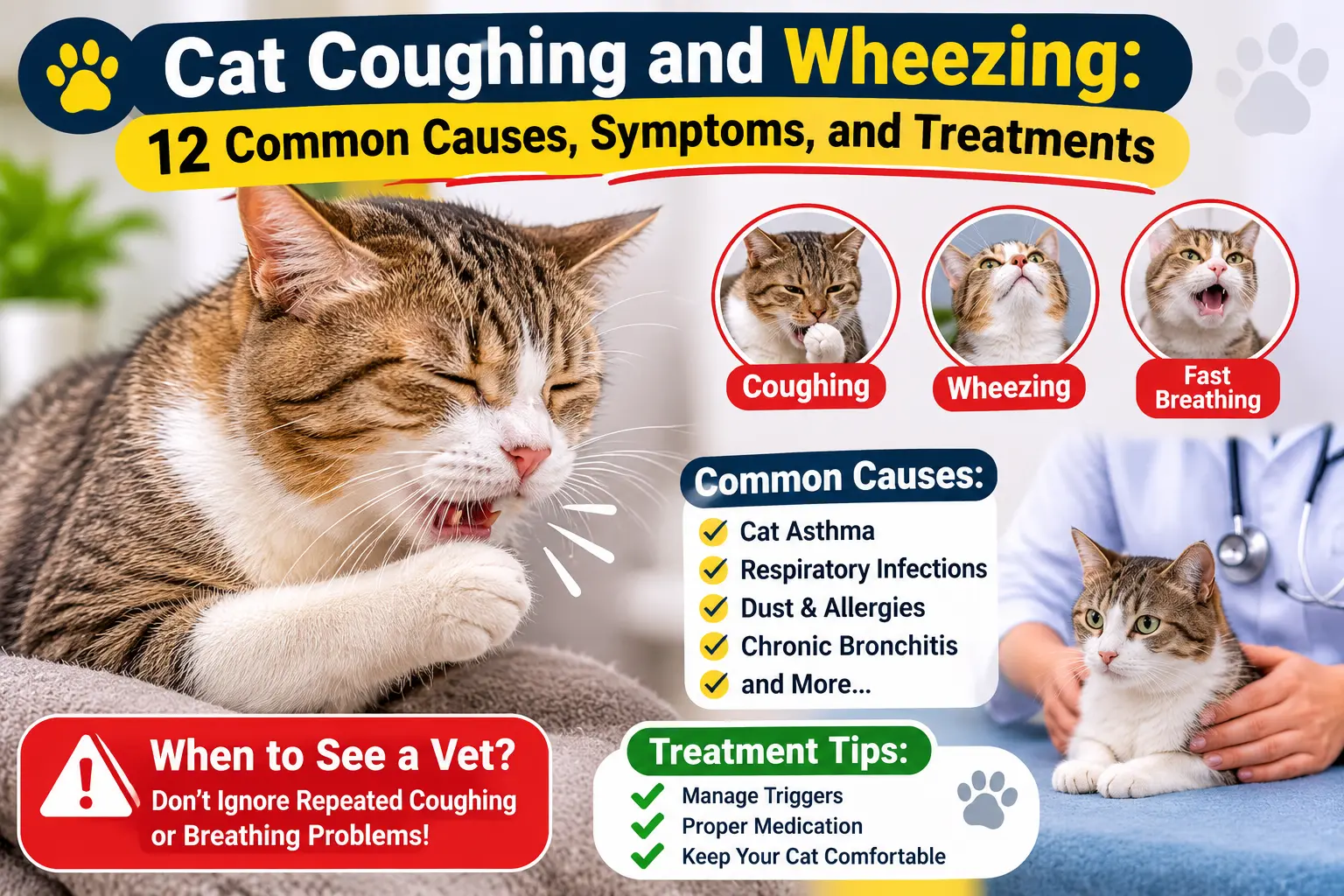
Hearing your cat cough or make a strange breathing sound can be frightening. You may notice your cat making a dry hacking noise, breathing with a whistle-like sound, or stretching its neck while trying to cough. Sometimes these signs happen for a short time, but repeated coughing and wheezing should never be ignored.
Cat coughing and wheezing can happen for several reasons. Dust, smoke, allergies, respiratory infections, asthma, and other health problems can affect a cat’s airways and make breathing difficult.
Some causes are mild, while others need quick medical attention. Understanding the symptoms can help you recognize when your cat needs veterinary care.
In this guide, we explain 12 common causes of cat coughing and wheezing, their warning signs, possible treatments, and ways to protect your cat’s respiratory health.
What Is Cat Coughing and Wheezing?
Coughing is a natural body response that helps remove unwanted particles, mucus, and other irritants from the airways.
When a cat coughs, it may lower its body, stretch its neck forward, and make a repeated hacking sound.
Wheezing is a different problem. It is a high-pitched whistling sound that happens when air moves through narrowed or irritated airways.
A cat may experience coughing and wheezing at the same time, especially when its lungs or breathing passages are affected.
Common signs include:
- Repeated dry coughing
- Whistling sounds while breathing
- Fast or noisy breathing
- Stretching the neck while coughing
- Breathing with an open mouth
- Less interest in playing
- Low energy or unusual tiredness
Important: If your cat is struggling to breathe, breathing with its mouth open, or has blue or gray gums, seek emergency veterinary care immediately.
12 Common Causes of Cat Coughing and Wheezing
There are several reasons why cats develop breathing problems. Here are the most common causes explained in simple words.
1. Cat Asthma
Cat asthma is one of the important causes of repeated coughing and wheezing.
Asthma happens when a cat’s airways become inflamed and narrow. These airways carry air into and out of the lungs. When they become swollen, breathing becomes difficult.
Certain airborne particles may trigger an asthma reaction. These can include dust, pollen, smoke, and other irritants.
Common symptoms of cat asthma:
- Repeated dry coughing
- Wheezing while breathing
- Fast breathing
- Stretching the neck forward
- Sitting in a low, crouched position
- Breathing with an open mouth during a serious attack
Some cats experience mild symptoms occasionally, while others may have severe breathing attacks.
What can help?
A veterinarian may recommend anti-inflammatory medicine, inhaled medication, or other treatment depending on the cat’s condition.
Keep your home free from cigarette smoke, dusty litter, strong perfumes, and other possible triggers.
Cat asthma is usually a long-term condition that needs proper management.
2. Respiratory Infections
Respiratory infections can affect a cat’s nose, throat, and lungs.
These infections may be caused by viruses or bacteria. Some common feline respiratory viruses include feline herpesvirus and feline calicivirus.
Cats living with several other cats may have a higher risk of catching contagious infections.
Possible symptoms include:
- Coughing
- Sneezing
- Runny nose
- Watery eyes
- Fever
- Reduced appetite
- Low energy
- Noisy breathing
Some infections mainly affect the upper respiratory system, while others may involve the lower airways.
What should you do?
Keep your cat comfortable and contact a veterinarian if symptoms continue or become worse.
If you have several cats, ask your vet whether the sick cat should be kept separate to reduce the risk of spreading infection.
Never give antibiotics without veterinary advice because not every respiratory infection is bacterial.
3. Dust and Environmental Allergies
Dust and other airborne particles can irritate a cat’s breathing passages.
Cats spend a lot of time close to the floor, where dust and small particles can collect. These particles may enter their nose and airways when they breathe.
Common environmental irritants include:
- Dust from cat litter
- Pollen from plants
- Mold
- Cigarette smoke
- Perfumes
- Air fresheners
- Cleaning sprays
- Scented candles
Some cats may be more sensitive to these substances than others.
Symptoms may include:
- Occasional coughing
- Sneezing
- Watery eyes
- Wheezing
- Nose irritation
How can you help?
Use low-dust, unscented cat litter. Clean your home regularly and avoid smoking near your pet.
Do not spray perfumes or strong cleaning products around your cat.
If coughing continues even after removing possible irritants, arrange a veterinary examination.
4. Chronic Bronchitis
Chronic bronchitis is a condition in which the breathing tubes inside the lungs remain irritated and inflamed for a long time.
These tubes help move air into and out of the lungs. When their lining becomes swollen, they may produce extra mucus and become narrower.
This can make breathing uncomfortable for your cat.
Common signs include:
- Regular dry coughing
- Wheezing
- Noisy breathing
- Coughing after activity
- Reduced energy
- Difficulty breathing in severe cases
Chronic bronchitis can look similar to cat asthma. A veterinarian may need tests to understand which condition is affecting your cat.
Treatment:
Treatment depends on the cause and severity. A veterinarian may prescribe anti-inflammatory medicine or other medication to help control airway irritation.
Avoid smoke, dust, and other substances that may make the condition worse.
5. Heartworm Disease
Heartworm disease is caused by parasitic worms that are spread through mosquito bites.
Although heartworms are commonly discussed in dogs, cats can also become infected.
In cats, these parasites may affect the lungs and cause breathing problems. Some cats develop a condition called heartworm-associated respiratory disease.
Possible symptoms include:
- Coughing
- Wheezing
- Fast breathing
- Vomiting
- Reduced appetite
- Weight loss
- Sudden breathing problems
Some infected cats may show very few warning signs.
What should you do?
Ask your veterinarian about suitable parasite prevention for your cat.
Heartworm disease can be difficult to diagnose in cats, so your vet may recommend blood tests, imaging, or other examinations.
Do not use dog heartworm medication on a cat unless a veterinarian specifically prescribes an appropriate product.
6. Pneumonia
Pneumonia is an infection or inflammation of the lungs.
It can happen when bacteria, viruses, fungi, or other problems affect the lung tissue.
When the lungs become inflamed, breathing becomes harder because the body cannot move air normally.
Common symptoms include:
- Coughing
- Fast breathing
- Difficulty breathing
- Fever
- Weakness
- Loss of appetite
- Unusual tiredness
Some cats may also make unusual sounds while breathing.
Treatment:
Pneumonia requires veterinary examination. Treatment depends on the cause and may include prescribed medication, oxygen support, fluids, or other medical care.
If your cat has fast or difficult breathing, do not wait for the symptoms to disappear on their own.
7. Foreign Objects Stuck in the Airway
Cats are curious animals. They may sniff, chew, or play with small objects around the home.
Sometimes, a small object or piece of plant material can enter the airway and cause irritation or blockage.
Possible objects include:
- Grass pieces
- Small plant materials
- Dust particles
- Tiny pieces of toys
- Other foreign materials
Warning signs may include:
- Sudden coughing
- Repeated gagging
- Noisy breathing
- Excessive drooling
- Difficulty breathing
- Panic or unusual behavior
If your cat suddenly starts coughing severely or appears unable to breathe, seek emergency veterinary help.
Do not put your fingers deep into the cat’s throat or try to remove an object you cannot clearly and safely reach.
8. Fungal Infections
Some fungal infections can affect a cat’s respiratory system.
Cats may come into contact with fungal organisms through soil, dust, or outdoor environments.
Depending on the infection, the nose, lungs, or other body parts may be affected.
Possible symptoms include:
- Coughing
- Sneezing
- Nasal discharge
- Noisy breathing
- Weight loss
- Low energy
- Difficulty breathing
Some fungal infections can become serious if they are not treated.
A veterinarian may recommend blood tests, imaging, or laboratory testing to identify the infection.
Treatment usually requires specific antifungal medication prescribed by a veterinarian.
9. Lungworms and Other Parasites
Some parasites can live in or affect a cat’s lungs and respiratory passages.
Lungworm infections may cause inflammation in the airways and make breathing difficult.
Cats may become infected through exposure to infected prey, snails, slugs, or contaminated environments, depending on the parasite.
Common symptoms include:
- Persistent coughing
- Wheezing
- Fast breathing
- Difficulty breathing
- Reduced appetite
- Weight loss
Not every cat with lungworms shows obvious symptoms.
A veterinarian may examine stool samples or recommend other tests to find the cause.
Proper parasite prevention and treatment can help protect your cat.
10. Nasal Problems and Upper Airway Blockage
Sometimes, breathing noises do not come from the lungs. They may come from problems inside the nose or throat.
Nasal inflammation, mucus, polyps, or other growths can partially block the airflow.
This may produce snoring-like sounds, noisy breathing, sneezing, or other unusual noises.
Possible symptoms include:
- Noisy breathing
- Frequent sneezing
- Nasal discharge
- Snoring sounds while awake
- Difficulty breathing through the nose
- Reduced interest in food
If these symptoms continue, your veterinarian should examine your cat’s nose and throat.
The treatment depends on the problem causing the blockage.
11. Lung Tumors
Although less common than asthma or respiratory infections, tumors can also affect a cat’s lungs or breathing passages.
Tumors may interfere with normal airflow or affect the surrounding lung tissue.
Older cats may need a more detailed examination if they develop a new, persistent cough.
Possible warning signs include:
- Long-lasting coughing
- Difficulty breathing
- Weight loss
- Poor appetite
- Low energy
- Reduced activity
A veterinarian may recommend chest X-rays, ultrasound, or other tests to investigate the problem.
Treatment depends on the type, location, and stage of the tumor.
12. Heart and Other Serious Health Conditions
Some serious health conditions can affect how comfortably a cat breathes.
For example, fluid may collect around the lungs due to certain heart conditions or other diseases. This is called pleural effusion.
When fluid takes up space around the lungs, the lungs cannot expand normally.
Warning signs include:
- Fast breathing
- Shallow breathing
- Open-mouth breathing
- Weakness
- Reduced appetite
- Difficulty resting comfortably
Heart disease in cats does not usually cause coughing as commonly as it does in dogs. However, heart-related problems can cause serious breathing difficulties.
If your cat has trouble breathing, seek emergency veterinary attention immediately.
How to Tell If Your Cat Is Coughing or Trying to Vomit a Hairball
Many cat owners confuse coughing with hairball vomiting because the sounds can be similar.
However, these are different body actions.
| Cat coughing | Hairball vomiting |
|---|---|
| Usually starts with a breathing-related hacking sound | Usually involves repeated retching |
| Cat may crouch and stretch its neck | Cat may show strong abdominal movements |
| Often no material comes out | Hair or stomach contents may come out |
| Can be linked to airway problems | Often linked to swallowed fur |
If your cat repeatedly makes hacking sounds but never produces a hairball, it may actually be coughing.
A short video of the episode can help your veterinarian understand what is happening.
When Should You Worry About Cat Coughing and Wheezing?
Occasional mild coughing may not always mean a serious illness. However, repeated coughing, wheezing, and breathing changes need attention.
Seek emergency veterinary care immediately if your cat:
- Breathes with an open mouth.
- Struggles to take a breath.
- Has blue, gray, or very pale gums.
- Shows strong movement of the chest or belly while breathing.
- Collapses or becomes extremely weak.
- Suddenly develops severe breathing problems.
- Coughs up blood.
Do not wait to see whether these symptoms disappear.
If coughing happens repeatedly, continues for more than a short period, or keeps returning, arrange a veterinary appointment even if your cat seems normal between episodes.
How Do Veterinarians Diagnose Cat Coughing and Wheezing?
A veterinarian first checks your cat’s breathing, listens to the chest, and asks questions about its symptoms.
You may be asked:
- When did the coughing begin?
- Does it happen every day?
- Does your cat cough after playing?
- Is your cat eating normally?
- Have you noticed sneezing or nasal discharge?
- Has anything changed in your home?
Depending on the symptoms, the veterinarian may recommend:
1. Physical Examination: The vet checks the breathing pattern, heart, lungs, and general health.
2. Chest X-rays: These can help identify changes in the lungs, airways, or chest.
3. Blood Tests: Blood tests may help identify infection or other health problems.
4. Parasite Testing: Tests may be recommended if lungworms or other parasites are suspected.
5. Airway Examination: In some cases, the vet may use a small camera or collect samples from the airways for further testing.
Not every cat needs every test. The veterinarian chooses tests based on the symptoms and examination.
How Is Cat Coughing and Wheezing Treated?
There is no single treatment for every coughing cat. The correct treatment depends on the underlying cause.
Here are some examples:
- Asthma: Anti-inflammatory medicines and inhaled treatments may help control airway inflammation.
- Bacterial infections: A veterinarian may prescribe antibiotics when a bacterial infection is confirmed or strongly suspected.
- Fungal infections: Specific antifungal medicines may be needed.
- Parasites: Suitable parasite treatment may be prescribed.
- Pneumonia: Treatment may include medication, oxygen support, and fluids.
- Foreign objects: A veterinarian may need to remove the object.
- Chronic bronchitis: Long-term treatment may be needed to control inflammation.
Never give human cough syrup, cold medicine, or leftover antibiotics to your cat.
Some medicines that are safe for people can be dangerous for cats.
What Can You Do at Home to Help a Coughing Cat?
Home care can help reduce exposure to irritants, but it cannot replace veterinary treatment when a medical problem is present.
Here are some helpful steps:
1. Keep Your Home Dust-Free
Clean floors, furniture, and sleeping areas regularly. Dust can irritate sensitive airways.
2. Avoid Cigarette Smoke
Smoke can irritate your cat’s respiratory system. Never smoke around your pet.
3. Use Unscented Cat Litter
Choose low-dust, unscented litter to reduce airborne particles.
4. Avoid Strong Perfumes
Do not use strong room sprays, scented candles, or air fresheners near your cat.
5. Keep Your Cat Comfortable
Provide a clean, quiet, and comfortable place to rest.
6. Monitor Breathing
Pay attention to your cat’s breathing while resting. If breathing becomes fast, difficult, or open-mouthed, seek emergency veterinary help.
7. Record Coughing Episodes
Take a short video if it is safe to do so. Record when the coughing happens and how long it lasts.
This information can help your veterinarian.
How to Prevent Coughing and Wheezing in Cats
You cannot prevent every respiratory illness, but some simple habits can reduce certain risks.
- Keep your cat’s living area clean.
- Avoid cigarette smoke and strong chemical sprays.
- Use low-dust litter.
- Follow your veterinarian’s vaccination advice.
- Ask about suitable parasite prevention.
- Keep toxic chemicals away from pets.
- Arrange regular veterinary checkups.
- Avoid contact with sick cats when possible.
- Monitor unusual breathing sounds.
Early attention to respiratory symptoms can help prevent some conditions from becoming more serious.
Frequently Asked Questions (FAQs)
1. Why is my cat coughing and wheezing?
Cats may cough and wheeze because of asthma, bronchitis, respiratory infections, allergies, parasites, or airway irritation. Repeated symptoms need veterinary examination to identify the cause.
2. Is cat coughing always a sign of asthma?
No. Asthma is one possible cause, but infections, bronchitis, parasites, foreign objects, and other conditions can also cause coughing. A veterinarian needs to determine the correct cause.
3. Why does my cat make a wheezing sound when breathing?
Wheezing can happen when the airways become narrow or irritated. Asthma and bronchitis are possible causes. Wheezing with difficult or open-mouth breathing is an emergency.
4. Can dust make my cat cough?
Yes. Dust from litter, household surfaces, and other airborne particles can irritate a cat’s airways. Using low-dust litter and keeping your home clean may help.
5. Can cat coughing go away on its own?
Mild irritation may improve after the trigger is removed. However, persistent or repeated coughing may indicate an underlying medical condition. It should be checked by a veterinarian.
6. Why does my cat cough but nothing comes out?
Cats with airway problems may produce a dry cough without bringing up anything. Sometimes owners mistake coughing for an attempt to produce a hairball. Repeated episodes should be checked.
7. Can a hairball cause coughing in cats?
Hairballs usually cause gagging and retching rather than a true respiratory cough. If your cat repeatedly hacks without producing a hairball, a respiratory problem may be involved.
8. Is cat wheezing dangerous?
It can be. Mild wheezing may be related to airway irritation, but severe wheezing or difficulty breathing can indicate a serious problem. Open-mouth breathing requires immediate veterinary care.
9. What can I give my cat for coughing?
Do not give human cough medicines or other medicines without veterinary advice. Treatment depends on the underlying cause and may involve prescribed inhalers, anti-inflammatory medicines, or other treatments.
10. When should I take my coughing cat to the vet?
Arrange a veterinary appointment if coughing is frequent, persistent, or getting worse. Seek emergency help immediately if your cat struggles to breathe, breathes with an open mouth, collapses, or has blue or gray gums.
Final Thoughts
Cat coughing and wheezing should not be ignored, especially when the symptoms happen repeatedly.
Sometimes, dust or other environmental irritants can affect a cat’s breathing. In other cases, asthma, bronchitis, infections, parasites, or more serious health conditions may be responsible.
The most important thing is to watch your cat’s breathing and behavior. Do not try to treat repeated coughing with human medicines or home remedies.
If your cat has difficulty breathing, seek emergency veterinary care immediately. Early diagnosis and the right treatment can help protect your cat’s health and comfort.